
Can a hospital bill exceed $66,000 while the patient is responsible for less than $1,000?
A real hospital insurance claim shared with CASPI Insurance Agency shows exactly that contrast: $66,598.34 in billed charges and $979.29 listed as the patient’s responsibility.
These numbers illustrate an important lesson about health insurance in the United States: the amount a hospital bills is not necessarily the amount a patient owes.
Understanding hospital bills with insurance can help Virginia residents make informed decisions, identify potential billing errors, and choose health coverage that better fits their needs.
In this guide, we’ll explain the real case, how to read an Explanation of Benefits (EOB), what deductibles and coinsurance mean, and what to do when you receive a large medical bill.
Real Case Study: A $66,598 Hospital Claim With $979 in Patient Responsibility
CASPI Insurance Agency received permission to share an anonymized example based on a real client’s hospital insurance document.
The document lists services dated September 25, 2026, including laboratory testing, diagnostic procedures, emergency room services, and other hospital-related charges.
The financial summary shows:
| Information on the Document | Amount |
|---|---|
| Total Amount Billed | $66,598.34 |
| Patient’s Responsibility | $979.29 |
| Difference Between the Two Amounts | $65,619.05 |
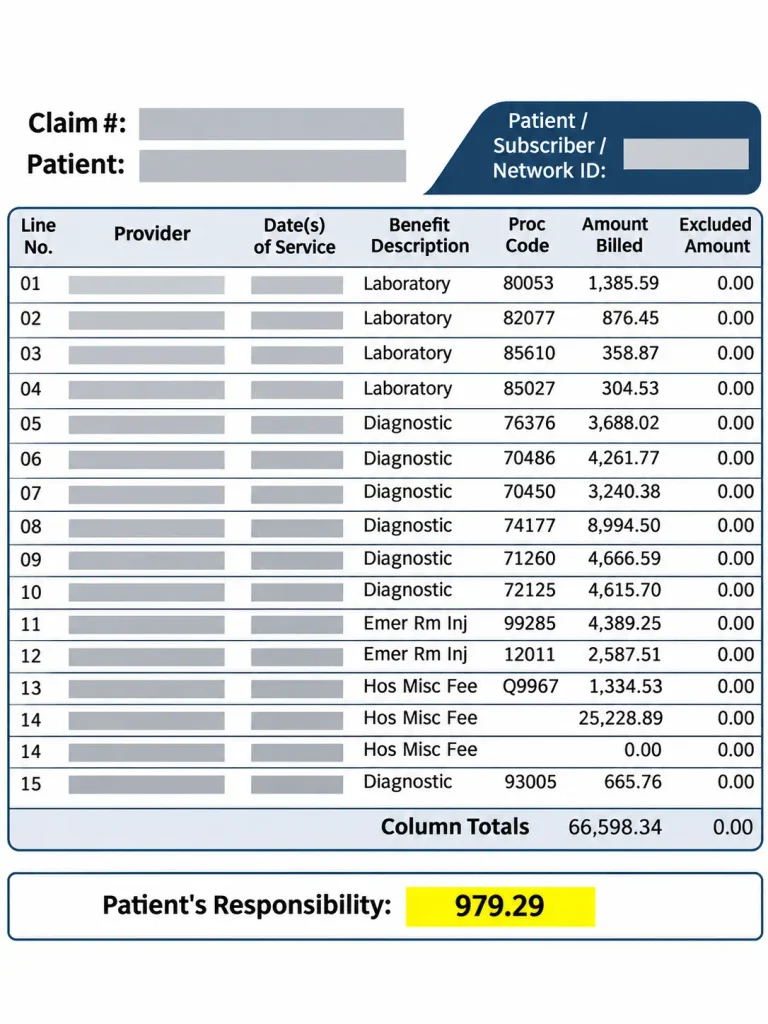
The patient’s listed responsibility represents approximately 1.47% of the original billed charges.
That is a substantial difference, but it is important to interpret the numbers correctly.
The $65,619.05 difference does not necessarily represent the amount paid by the insurance company.
The difference may reflect insurance payments, contractual adjustments, negotiated rates, or other claim-processing factors.
The available document does not provide a complete breakdown of all these components. It also does not establish that the patient has already paid the $979.29.
What Does This Real Claim Teach Us?
A large hospital charge can be frightening, especially for someone unfamiliar with how health insurance claims are processed.
But before assuming that the entire amount must be paid, patients should distinguish between:
- The hospital’s original charges
- The insurer’s allowed amount, when applicable
- Contractual adjustments
- Insurance payments
- The patient’s responsibility
The figures in this case are not a prediction of what another patient would owe. Different health insurance plans, medical conditions, hospitals, and services can produce very different results.
The lesson is not that health insurance always reduces a $66,000 bill to $979. The lesson is to understand the actual claim calculation before assuming what you owe.
[Insert the anonymized real hospital claim image here. Suggested caption: “Anonymized hospital insurance document shared with permission. Total billed charges: $66,598.34. Listed patient responsibility: $979.29.”]
Why Are Hospital Bills So Expensive in the United States?
A hospital visit may involve many separate medical services, each with its own charges.
Depending on the medical situation, a hospital bill may include:
- Emergency department facility charges
- Physician and specialist services
- Diagnostic imaging, such as CT scans or X-rays
- Laboratory tests
- Medications administered during treatment
- Medical procedures
- Medical equipment and supplies
- Observation or inpatient services
A relatively short hospital encounter can involve costly diagnostic testing or specialized treatment. However, the length of a visit alone does not determine the total cost.
Hospital charges also vary by facility, geographic market, service type, and insurance arrangements.
Why Can Two Hospitals Charge Different Amounts?
Hospitals may have different pricing structures and negotiated contracts with insurance companies.
For similar services, one facility’s gross charges may differ substantially from another’s.
These advertised or billed amounts also may not represent the final amount collected from the patient and insurer.
The Centers for Medicare & Medicaid Services (CMS) requires hospitals to publish standard charge information to help consumers better understand and compare prices.
You can learn more through the CMS Hospital Price Transparency program.
How Do Hospital Bills With Insurance Work?
One of the most important parts of understanding medical bills is recognizing that several different dollar amounts can appear on the same claim.
| Term | What It Means |
|---|---|
| Amount Billed | The amount initially charged by the medical provider |
| Allowed Amount | The amount recognized under the applicable insurance arrangement |
| Contractual Adjustment | A reduction based on an applicable agreement or billing arrangement |
| Insurance Payment | The amount paid by the health insurance plan |
| Patient Responsibility | The amount assigned to the patient under the processed claim |
| Balance Due | The amount the provider currently requests from the patient, taking applicable prior payments into account |
An Example of How These Amounts Differ
Consider a separate, hypothetical insurance claim:
- Hospital billed charges: $10,000
- Allowed amount for covered in-network services: $6,000
- Applicable contractual adjustment: $4,000
- Patient responsibility under the plan: $1,500
- Insurance payment: $4,500
In this simplified example, the original $10,000 hospital charge results in a $1,500 patient responsibility.
This is not the calculation from CASPI’s real client case. It is a separate educational example showing how insurance arrangements can affect billing.
Actual claim processing depends on the plan’s coverage, deductibles, coinsurance, network rules, and other conditions.
How to Read Your Explanation of Benefits (EOB)
After a provider submits a health insurance claim, the insurer may send the patient an Explanation of Benefits.
An EOB is not a medical bill.
It explains how the insurance plan processed the claim, which services were considered, what the insurer paid, and what amount may be the patient’s responsibility.
According to CMS, an EOB can include the following information:
| EOB Field | What to Check |
|---|---|
| Date of Service | When the medical service occurred |
| Provider | Which hospital, physician, or facility submitted the claim |
| Service Description | What treatment or procedure was reported |
| Amount Billed | The provider’s original charge |
| Allowed Amount | The recognized amount under the insurance arrangement |
| Insurance Payment | The amount the insurer paid |
| Patient Responsibility | What the patient may owe |
| Remark or Explanation Codes | Notes explaining adjustments, denials, or coverage decisions |
Is the EOB the Same as a Hospital Bill?
No.
The EOB explains the insurer’s processing of the claim. The hospital or medical provider may send a separate statement requesting payment.
The provider’s bill should be compared with the EOB before payment.
If the provider requests more than the EOB indicates is owed for the same processed services, contact both the billing department and the insurer to understand the difference.
Remember that an EOB may not reflect amounts you have already paid directly to the provider.
For a detailed explanation, visit CMS: How to Read an Explanation of Benefits.
How Do Deductibles, Copays, and Coinsurance Affect Hospital Bills?
Even when medical services are covered, health insurance does not necessarily pay every dollar.
Most plans involve some combination of premiums, deductibles, copayments, and coinsurance.
What Is a Health Insurance Deductible?
A deductible is the amount you pay for certain covered services before the plan begins paying according to its applicable cost-sharing rules.
For example, a plan might have a $2,000 annual deductible.
If the deductible applies and you have not met any of it, you may have to pay the first $2,000 of eligible allowed expenses before the plan begins paying a percentage of the remaining amount.
Some services may be covered before the deductible is met.
What Is Coinsurance?
Coinsurance is the percentage of eligible costs you pay under the policy.
Suppose a covered service has an allowed amount of $5,000 and the deductible has already been met.
With 20% coinsurance:
| Payment | Amount |
|---|---|
| Allowed Amount | $5,000 |
| Patient Pays 20% | $1,000 |
| Insurance Pays 80% | $4,000 |
This example assumes no other limitations or cost-sharing conditions apply.
What Is a Copayment?
A copayment, or copay, is a fixed amount charged for certain covered services.
A policy might apply different copays to primary care visits, specialists, urgent care, or emergency room services.
The exact amount and whether a deductible also applies depend on the health plan.
What Is an Out-of-Pocket Maximum?
An out-of-pocket maximum is the most a person generally pays during a plan year for covered in-network services subject to that limit.
Once the applicable maximum is reached, the insurance plan generally pays 100% of covered in-network benefits for the remainder of the plan year.
For Marketplace plans, the federal ceilings are:
| Plan Year | Individual Maximum | Family Maximum |
|---|---|---|
| 2026 | $10,600 | $21,200 |
| 2027 | $12,000 | $24,000 |
These are maximum permitted limits for the relevant Marketplace coverage, not the amounts charged by every plan. Many plans have lower limits.
Monthly premiums, noncovered services, and many out-of-network expenses do not count toward the in-network out-of-pocket maximum.
Different types of health coverage may follow different rules.
Review the official HealthCare.gov out-of-pocket maximum explanation.
Important: We cannot determine whether the out-of-pocket maximum caused the $979.29 patient responsibility in CASPI’s real claim. The available document does not establish that connection.
What Should You Do If You Receive a Large Hospital Bill?
A large hospital bill does not automatically mean that every listed charge is incorrect. However, reviewing the information before paying can help identify errors and prevent unnecessary expenses.
Step 1: Request an Itemized Medical Bill
Ask the hospital’s billing department for a detailed statement listing each service, procedure, and charge.
Review the statement for duplicate items, unfamiliar services, and dates that do not match your medical visit.
Step 2: Compare the Bill With Your EOB
Check the provider, date of service, billed charges, insurer payment, and patient responsibility.
If the amounts do not match, ask the provider and insurance company to explain why.
Step 3: Verify How the Insurance Claim Was Processed
Contact your insurance company and ask whether:
- The claim was processed as in-network or out-of-network
- The services were covered
- Your deductible or coinsurance applied
- Any services were denied
- Any corrections or additional claims are pending
Keep the claim reference number and notes from the conversation.
Step 4: Check for Billing or Coding Errors
Billing mistakes can sometimes arise from incorrect codes, duplicate charges, or inaccurate insurance information.
If a charge appears inconsistent with the services you received, request clarification from the provider.
You may also compare the statement with available medical records.
Step 5: Ask About Financial Assistance and Payment Options
If you are unable to pay the amount owed, ask whether the hospital offers:
- Financial assistance or charity care
- Reduced payment arrangements
- Interest-free or other payment plans
- Additional billing reviews
Programs and eligibility requirements vary by hospital.
Step 6: Appeal an Insurance Denial When Appropriate
If your insurer denies a service you believe should be covered, review the explanation of the denial.
Depending on your plan and the situation, you may have the right to an internal appeal and an independent external review.
For applicable health plans, an internal appeal generally must be filed within 180 days of receiving the denial notice.
Different rules can apply in urgent circumstances or under certain coverage programs.
Read the official HealthCare.gov guide to appealing an insurance decision.
For practical billing guidance, CMS also provides a medical bill error checklist.
Does the No Surprises Act Protect You From Unexpected Hospital Bills?
The federal No Surprises Act provides important protections against certain unexpected out-of-network medical bills.
For most applicable private health insurance plans, emergency services generally receive protections that limit patient cost-sharing to in-network levels, even when the emergency provider is out of network.
The law also addresses certain non-emergency services performed by out-of-network providers at participating in-network facilities.
What Does the Protection Mean?
Suppose you receive emergency care from an out-of-network hospital covered by the applicable federal protections.
In many cases, the provider cannot bill you for an additional out-of-network balance beyond the legally permitted cost-sharing amount.
You may still owe applicable in-network deductibles, copayments, or coinsurance.
Are All Medical Bills Protected?
No. Exceptions and limitations exist.
For example:
- Ground ambulance services generally are not protected by the federal No Surprises Act’s balance-billing restrictions, although state protections may apply.
- Certain post-stabilization services have specific consent rules.
- Not every insurance product is subject to the same protections.
- Services that are not covered under a plan may raise different billing issues.
Patients should not assume that every out-of-network bill is automatically prohibited.
For details, visit CMS: Know Your Medical Bill Rights When Using Insurance.
How Can You Estimate Hospital Costs Before Treatment?
For non-emergency care, researching potential costs before treatment can help you make more informed decisions.
Check the Hospital’s Price Information
Hospitals generally must make specified standard charge information publicly available, including information relevant to scheduled procedures.
Some hospitals also provide online tools that estimate patient costs for particular services.
However, a published price may not equal your final out-of-pocket cost.
Ask Your Insurance Company for an Estimate
Before a planned procedure, ask:
- Is the hospital in my plan’s network?
- Is the treating physician also in-network?
- Does the service require prior authorization?
- What deductible or coinsurance applies?
- How much of my out-of-pocket maximum have I already met?
- Could there be separate professional or facility charges?
You can also explore the FAIR Health Consumer cost-estimation resources.
For a medical emergency, do not delay necessary emergency treatment to compare prices.
How to Choose Health Insurance in Virginia
The most affordable monthly premium does not necessarily mean the lowest total health care cost.
A plan with a low premium may have a higher deductible or larger patient cost-sharing obligations.
Likewise, a more expensive monthly plan may offer different cost-sharing arrangements or provider access.
When comparing plans, consider the full financial picture.
| Plan Feature | What You Should Review |
|---|---|
| Monthly Premium | Your recurring cost for maintaining coverage |
| Deductible | Amount that may apply before certain benefits begin |
| Copayment | Fixed payment for selected covered services |
| Coinsurance | Your percentage of eligible costs |
| Out-of-Pocket Maximum | Applicable annual limit for covered in-network cost-sharing |
| Provider Network | Access to preferred hospitals and physicians |
| Prescription Benefits | Medication coverage, tiers, and costs |
| Emergency Coverage | Emergency service benefits and cost-sharing |
| Hospitalization Benefits | Inpatient coverage and related expenses |
HMO, PPO, and EPO: Why Does the Network Matter?
Different health insurance plan types can have different provider-access rules.
HMO (Health Maintenance Organization): Usually limits non-emergency coverage to participating providers and may require referrals or other managed-care arrangements.
PPO (Preferred Provider Organization): Generally provides more flexibility to use out-of-network providers, although doing so usually costs more.
EPO (Exclusive Provider Organization): Generally covers care within the network, with exceptions such as emergency services.
The exact benefits depend on the particular plan, not only its HMO, PPO, or EPO label.
Where Can Virginia Residents Compare Health Insurance Plans?
Individuals and families can explore Marketplace coverage through Virginia’s Insurance Marketplace.
The Marketplace allows eligible residents to compare plans and check their eligibility for financial assistance.
For the 2027 coverage year, Virginia’s Open Enrollment period runs from November 1, 2026, through January 29, 2027.
Virginia also introduced a state-funded program called Virginia Premium Savings for eligible 2027 Marketplace enrollees. Assistance depends on factors such as household income, family size, and plan selection.
These premium savings are separate from the medical billing concepts discussed in this article.
For details, see Virginia Premium Savings.
Health Insurance Considerations for Fairfax and Northern Virginia Residents
Health insurance choices can be particularly important for residents who receive care across Northern Virginia, Maryland, and Washington, DC.
For example, a Fairfax resident may want access to a specific hospital in Virginia while also visiting specialists in another jurisdiction.
Before choosing a policy, confirm whether the relevant providers and facilities are included in the plan’s network.
What Should Northern Virginia Families Consider?
- Preferred hospitals and primary care physicians
- Specialist access and referral requirements
- Expected annual medical expenses
- Regular prescription needs
- Household size and family coverage
- Network access across state lines
- Emergency and hospitalization benefits
- Monthly premiums and potential out-of-pocket costs
Living in Virginia does not automatically mean every hospital in Maryland or Washington, DC is treated as in-network.
Network participation is specific to the health plan and provider arrangements.
CASPI Insurance Agency serves individuals and families in Virginia, Maryland, and Washington, DC and can provide information about available health insurance options.
Explore CASPI Health Insurance Services
Frequently Asked Questions About Hospital Bills and Health Insurance
Can a hospital bill be $66,000 even if I have insurance?
Yes. A hospital’s initial billed charges can be very high even when a patient has insurance. However, the amount billed may differ significantly from the allowed amount and the patient’s final responsibility.
Does a $66,000 hospital bill mean I must pay $66,000?
Not necessarily. Insurance coverage, negotiated rates, contractual adjustments, deductibles, coinsurance, and other factors may change the amount owed.
How did the CASPI client’s $66,598 bill result in $979.29 patient responsibility?
The shared document confirms the two amounts but does not contain enough information to reconstruct the complete claim calculation. The precise roles of insurer payments, negotiated adjustments, and plan cost-sharing cannot be established from the available excerpt alone.
Is an Explanation of Benefits the same as a bill?
No. An EOB explains how the insurer processed a claim. A provider’s billing statement is the document that generally requests payment.
What if my hospital bill is higher than my EOB?
Compare the charges and contact the provider’s billing department and your insurer. The discrepancy may involve different claims, adjustments, pending processing, or an error requiring correction.
Does my deductible apply to emergency room visits?
It may. Deductibles, copayments, and coinsurance depend on the plan’s emergency services benefits and applicable rules.
Can I receive an out-of-network emergency bill?
Yes, but federal and state laws may restrict what providers can charge in certain situations. Federal surprise billing protections apply to many emergency services under most private health plans, with exceptions.
What happens after I reach my out-of-pocket maximum?
For covered in-network services subject to the applicable limit, your plan generally pays 100% of covered benefits for the rest of the plan year. Premiums and noncovered expenses are generally excluded.
Should I choose the cheapest health insurance plan?
Not automatically. Compare total expected annual costs, provider networks, deductibles, coinsurance, and out-of-pocket maximums before making a decision.
Where can I find health insurance in Virginia?
Eligible residents can compare individual and family plans through Virginia’s Insurance Marketplace. They can also explore available health insurance services and guidance through CASPI Insurance Agency.
Conclusion: A Hospital Bill Is Not Always What You Owe
The real CASPI client document showing $66,598.34 in hospital charges and $979.29 in patient responsibility demonstrates why understanding health insurance terminology matters.
But no two medical claims are identical.
A patient’s responsibility depends on the medical services received, the insurance plan, network arrangements, claim adjustments, and applicable cost-sharing rules.
Before paying a large medical bill, review the Explanation of Benefits, verify the provider’s charges, and contact the insurance company when information is unclear.
And before selecting health insurance, consider not only the monthly premium but also the deductible, coinsurance, provider network, and out-of-pocket maximum.
Looking for Health Insurance Options in Virginia, Maryland, or DC?
CASPI Insurance Agency can help you explore available health insurance options and better understand important policy features.
Explore Health Insurance With CASPI
Official Sources and Additional Reading
- CMS — How to Read an Explanation of Benefits
- CMS — Check Your Medical Bill for Errors
- CMS — Medical Bill Rights When Using Insurance
- CMS — Hospital Price Transparency
- HealthCare.gov — Out-of-Pocket Maximum
- HealthCare.gov — Your Total Health Care Costs
- Virginia’s Insurance Marketplace
- FAIR Health Consumer — Estimating Hospital Stay Costs
Editorial note: The real client example is presented with permission and without identifying patient information. The figures represent information shown in the available insurance document; they do not establish the full claim payment calculation.
Disclaimer: This article provides general educational information and should not be considered medical, legal, or individualized insurance advice. Coverage, claim payments, provider charges, and patient responsibilities depend on specific circumstances, insurance policy terms, and applicable law. Always confirm your benefits and billing questions with your insurer and health care provider.